Crypto as the casino is dead, the speculative premium is gone. The chaff blows away with the wind, and what remains is the foundational primitive of the world that's coming.
Altseason
In the cryptocurrency industry there is a concept of "altseason". A perfect storm where price insensitive capital flows and mass market psychosis create a hyper bull market where every coin in the entire asset class goes up simultaneously. A market environment where you can make money picking coins by throwing darts blindfolded. People in crypto speak of altseason like a mythical creature, like Captain Ahab chasing the white whale. Or like a heroin addict chasing the dragon.
It starts with a parabolic move up in Bitcoin. Bitcoin moving up psychologically validates the entire concept of cryptocurrency in the public consciousness. Outsiders who months ago knew nothing about the industry see social media posts of early investors making 10, 100, 1000x returns. They develop intense Fear Of Missing Out. They want to hit a ten bagger too. But they missed the main move; Bitcoin's too expensive now, can it really go up any more? Better to buy cheaper altcoins instead. At the same time, early Bitcoin investors take profit and rotate it into those same altcoins. Capital floods into low market cap, easily pumpable 'alts'. It doesn't matter that most of these alts are fundamentally worthless. A rising tide lifts all boats. Altseason comes like rain in the desert.
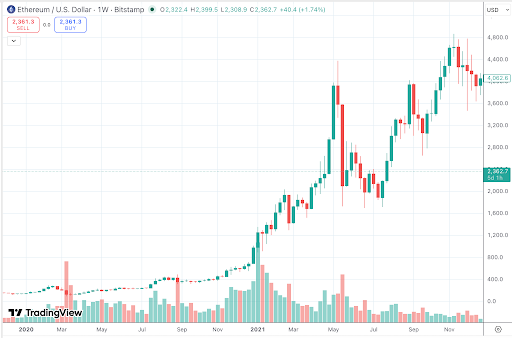
Or that's what the idea is anyway. The reality of the 2023-2025 crypto bull market was less pretty. Bitcoin did make a strong move to new highs, but there was no rising tide effect we saw in previous bull markets. Outperformance was limited to specific sectors, notably Solana and the memecoin ecosystem in late 2023 through 2024, an isolated ZEC pump in late 2025, and Hyperliquid. Outside of these sectors, most market participants were completely out of luck. Holding worthless altcoins, waiting for a promised altseason that never came. In the industry, we call these people "bagholders".
Some of the most pitiful bagholders were the Ethereum variety. Many traders thought that ETH, one of the few true blue chip coins, the world's first programmable money, which outperformed Bitcoin in both the 2017 and 2021 cycles, was an easy layup trade in the next one. But instead look at the ETH chart from 2024-2026:
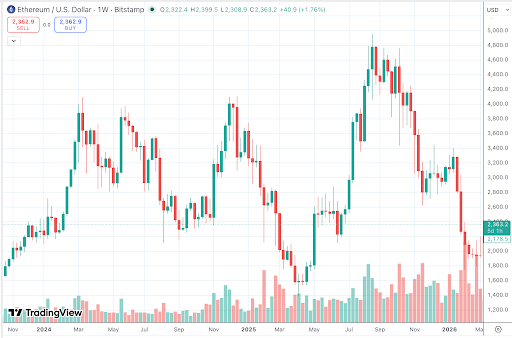
Brutal, schizophrenic price action. Put yourself in the mind of an ETH holder. You hold from the last cycle, or you buy the recovery in 2024, believing deep down in your heart that ETH is one day programmed for 10k. By the end of 2025 it crashes 70% down to the bear market lows, and a nauseatingly large portion of your net worth evaporates into thin air. You panic sell, wanting to preserve what you have left. Then Tom Lee gets on CNBC pumping his Digital Asset Treasury company. You know intellectually these DATs are fraudulent and unsustainable. But you watch ETH price whipsaw back up to ATH, and eventually you can't take the FOMO; you buy back in. Then immediately ETH crashes 60% back down again. Imagine the smell.
The price action in this bull market in general was vicious. Choppy, difficult to trade, difficult to hold. People got slaughtered running strategies they were rewarded generously for in previous markets. HODLers bled to death, breakout buyers got decapitated in a much quicker and more brutal fashion. By nature there was just too much fast money and too little regulation in crypto, and so larger and more sophisticated entities entered the space to prey on retail. Famously, Wintermute on the market making side and Binance on the exchange side.
On October 10th of 2025, crypto as the ultimate speculative casino died violently. Trump announced his latest round of China tariffs into thin Friday-evening liquidity. Crypto, running 24/7 with no circuit breakers, completely ate itself. Nineteen billion in leverage liquidated in a forty-minute window. Rumor has it that in those forty minutes Binance's matching engine froze and multiple large entities blew up catastrophically, pulling bids and wicking major tokens to near zero. But we may never know for sure. In crypto you never find the bodies.
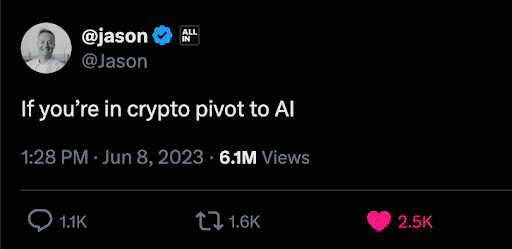
If You're In Crypto Pivot To AI
But speculative mania hasn't died at all, it's just moved elsewhere. Namely, the equities market. It started when OpenAI publicly released ChatGPT at the tail end of 2022 and the world suddenly realized what the future was going to look like. Shortly after, the world collectively realized the future was going to be built on GPUs, kicking off NVIDIA Corporation's legendary 10x run to become the biggest company in the world. Since then, every company involved in the AI supply chain has massively rerated to the upside. First NVIDIA and TSMC to make the GPUs, then Micron and Sandisk to provide the high speed memory, then Intel and AMD to make CPUs, Vertiv and Bloom Energy to power the datacenters; so on and so forth. Every time a sector runs, investors look to the next potential "bottleneck" in the supply chain, trying to frontrun the inevitable rotation.
After three years in this up-only regime, investors have grown increasingly brazen, and the rotations have become faster and more violent. Since mid-2025, semiconductor and memory stocks have been melting up Chernobyl style. Take a quick look at these charts, and try not to throw up:
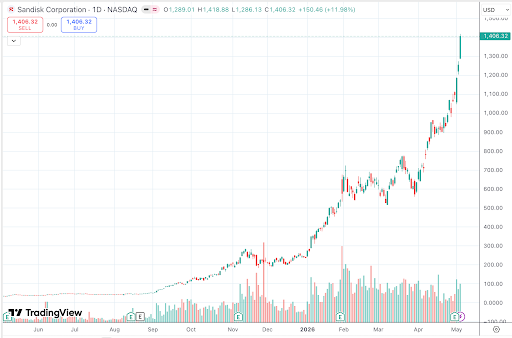
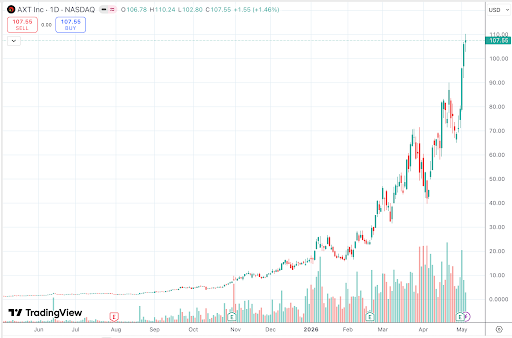
Here are those two stocks overlaid in green on the NVDA chart:
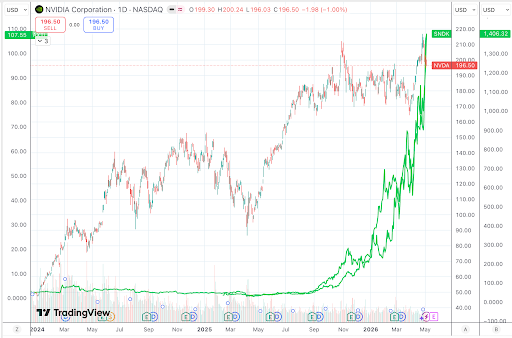
Do you notice something? The exact same crypto altseason pattern I described earlier is now happening in the broader equities market, with NVIDIA acting as Bitcoin. The AI revolution is a once in a lifetime story. It has distorted the NASDAQ into something monstrous, something more resembling the euphoria phase of a massive crypto bull run than a rational stock market, driven heavily by narrative and momentum rather than fundamentals.
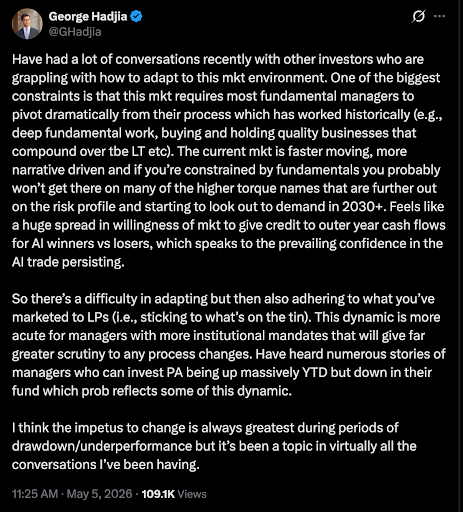
Vast institutional capital flows are no longer frontrunning your retail trades and dumping on you. They're playing rotations and catch-up trades just like the rest of us, desperately trying to adapt to the new environment and avoid underperformance all the while maintaining strict risk mandates. In a regime like this, the 'hedge' part of 'hedge fund' can be more of a handicap than anything. A portfolio manager can perform deep fundamental analysis and deliver his idiosyncratic, factor neutral 5% return with 2+ Sharpe. But in a market where anonymous X (formerly Twitter) users are posting 6000% YTD PNL screenshots, even a veteran PM might feel just a little twinge of FOMO. Maybe he wants to get in on this AI trade as well, and decides to allocate 1-2% of his 100M AUM into some "AI Bottleneck" microcap company. Maybe the trade turns out to be extremely lucrative, and his colleagues at different pods or firms start getting curious. And so the collective psychosis spreads…
In this light, is it any wonder why crypto is dead? The main appeal of crypto originally was as an alternative to traditional finance, a small pond where you could play amongst the fish instead of in the deep ocean hunted by Citadel and Jane Street sharks. A playground unconstrained by the cruelty of the Efficient Market Hypothesis, where assets constantly overshot any semblance of realistic valuation, where you could juice fantastical returns armed with nothing but hopes and dreams combined with a bit of basic technical analysis. Now, it turns out you can do that in the actual stock market too. And in the stock market you're buying ownership in wildly profitable companies with real tangible assets, instead of vaporware marketing itself as a blockchain. Why would anyone trade crypto? Every market is crypto now.
KOLs
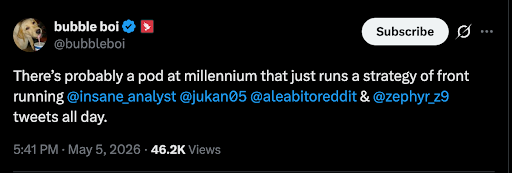
Social media culture is another area in which the traditional stock market has mirrored crypto. I mentioned X earlier. @bubbleboi is a notorious INTC bull with the aforementioned 6000% YTD screenshot, one of many anonymous stock pickers with eyewatering PNL numbers currently active on the platform. The other accounts mentioned in the screenshot are popular "AI Bottleneck" guys who have gathered cult followings by tweeting out theses for AI-adjacent microcaps that nobody has ever heard of, and subsequently making their followers a lot of money. In crypto, we would call these guys Key Opinion Leaders, or KOLs for short. In essence, social media influencers.
Back in crypto land, KOLs were an integral part of the ecosystem. For a long time, crypto was an industry where very few people actually understand the technology behind the projects, where valuations were derived from (extremely) optimistic extrapolations of the future rather than tangible revenue in the present, where "financial statement fraud" was more of a common business practice than a federal felony. All this created an environment where it was often difficult for investors to distinguish between fiction and reality, so assets moved primarily based on social media hype and narratives rather than actual revenue and fundamentals. KOLs on "Crypto Twitter" were the ones who wrote these narratives, and by extension moved the market.
You can draw the parallels to today's media ecosystem surrounding AI. It's not a 1-to-1 translation; the frontier labs are releasing genuinely world-changing products, and financial fraud is still mostly illegal in traditional finance. But the core characteristics of this market are the same: technology from the future that nobody really understands, and nosebleed valuations anchored by nebulous projections of future revenue. So the same dynamic emerges, of social media influencers selling dreams.
A reading list, for the curious
The unsettling thing is that even the most outlandish AI fever dreams are turning out to be disturbingly plausible. AGI timeline projections are far outside the scope of this essay, but there are three particular visions worth your time, ordered from earliest and most grounded to latest and most fantastical.
Citrini Research's May 2023 investment memo. The earliest call I'm aware of recommending chips and datacenter companies as picks and shovels plays, rather than trying to pick a winner out of the frontier labs. The original AI Bottleneck thesis, since vindicated a hundred times over.
Leopold Aschenbrenner's June 2024 Situational Awareness essay. "You can see the future first in San Francisco." Another investment thesis predicting exponential AI compute/infra buildout, culminating in governmental nationalization. After being fired from OpenAI, Aschenbrenner raised 225 million for a fund with this essay as the thesis. Within a year he 20xed it to 5.5 billion.
AI 2027, published April 2025 by a group of LessWrong writers. A cold vision of the future laying out the coming US-China arms race, and two possible paths we might take regarding alignment. Less of an investment thesis and more of a warning.
Metastasis
Crypto has broken containment. Or more specifically, the culture surrounding crypto has spread into other markets. Not just US equities— take a look at Pokemon cards or CounterStrike skins if you haven't recently. Speculative liquidity migrates wherever it wants to go. There is a hot ball of money bouncing around the global economy, and any market with scarce supply and low friction to trade is a ripe destination for the ball to land.
This is hyperfinancialization in action. The behavior pattern of crypto trading: narrative-driven, momentum-chasing, community-mediated, FOMO-fueled; has become the dominant behavior pattern of speculation everywhere. The ethos of crypto has metastasized into the broader world capital markets.
And metastasize is the right word, because this ethos is truly a cancer; once it takes root in your consciousness it cannot ever be fully excised. It asks in the back of your mind: what if fiat money isn't real? What if it hasn't been real since Nixon ended the gold standard in 1971? What if money doesn't mean anything until you have a certain amount of it, and hard work alone will never get you to that number, and so the only rational decision is to treat your money as a number in a video game, and hypergamble everything you're worth over and over until you're either bankrupt or on a yacht in Monaco? These thoughts are dangerously close to true, and you will subconsciously recognize them as such the second they form in your mind. Crypto was the canary in the coal mine, the first asset class so blatantly fraudulent and extractive that it broke the illusion of money as sacred.
Baudrillard describes four orders of simulacra. Four stages in the divorce between a sign and the thing it claims to represent. In the first, the simulation is a faithful representation of underlying reality. The stock market reflects the real economy. In the second, the simulation denatures and perverts reality. A juiced up stock market index covers up weaknesses in the real economy. In the third, the simulation masks the absence of the underlying reality. A doctored CPI print conceals the true rate of inflation, manipulated paper futures disguise the true state of the oil market. In the final stage, the simulation no longer refers to any reality at all— a memecoin that no longer pretends to have any fundamental value. Traditional finance is somewhere in the third order and descending. Crypto is waiting for us at the bottom.
But Baudrillard's ladder assumes a fixed world for the sign to drift away from. What happens when the underlying territory itself starts to change?
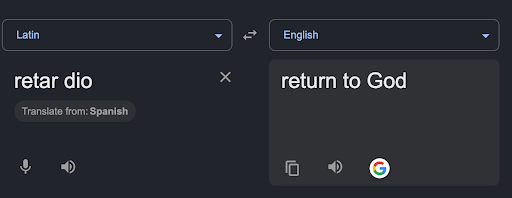
Return to God
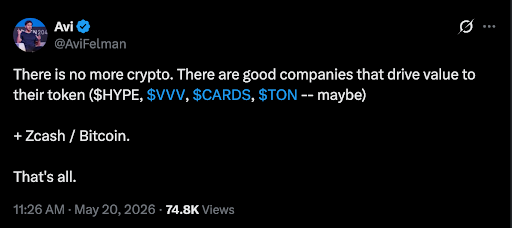
I want to end this essay by returning to the cryptocurrency industry. Crypto as the casino is dead, the speculative premium is gone, the hot ball of money has rolled on to greener equities. But maybe death was always priced in. Underneath the casino layer, what was crypto originally supposed to be? Decentralized money, programmable and freely transferable, self-custodial. That was the original pitch, the one that got buried under a decade of memecoins and leverage and Michael Saylor. The whole reason crypto existed, before it forgot, was to solve maybe the biggest problem of our age: fiat refers to nothing, and our generation is starting to notice.
For seventy years the dollar made sense because the labor force was growing and the system needed a currency that grew with it. An inflationary money for an inflating world. That world is over. The population curve has rolled over and it isn't coming back, and a currency built to debase against an expanding labor force is the wrong tool for a contracting one. Against this context, the case for a currency that doesn't inflate starts sounding less like a wishful fantasy and more like arithmetic.
And the state that issues the old money is hollowing out at the same time. This is an open secret, at least in the West. Everyone with money and power is quietly building an exit: a fund, a citizenship, a compound, a model. Power is leaving the state the same way value is leaving the currency, pooling in places that didn't exist twenty years ago. In ten years a frontier lab may be a more consequential institution than the government trying to regulate it. The state and its money are dying of the same disease.
This is the bet. That fiat is destined for zero, and that the world is moving towards the shape that crypto was originally built for. Now that the casino is gone and the chaff has blown away with the wind, what is left? Bitcoin, Hyperliquid, the stablecoins, the privacy coins; the projects with real referents and clear use cases in the coming world. Earlier I said that traditional finance is rapidly descending Baudrillard's ladder of simulacra. Crypto as the casino is waiting at the bottom of that ladder. But maybe crypto in its original ethos is at the bottom of a different structure, one that hasn't been built yet; the foundational base primitive of the future world financial system.
Maybe one day the mother of all bubbles will pop and the OpenAI/Anthropic IPOs will finally erase the concept of fiat money as a thing with value entirely. And maybe then we will find ourselves back in crypto, reborn from the ashes.
Crypto is dead. Long live crypto.